
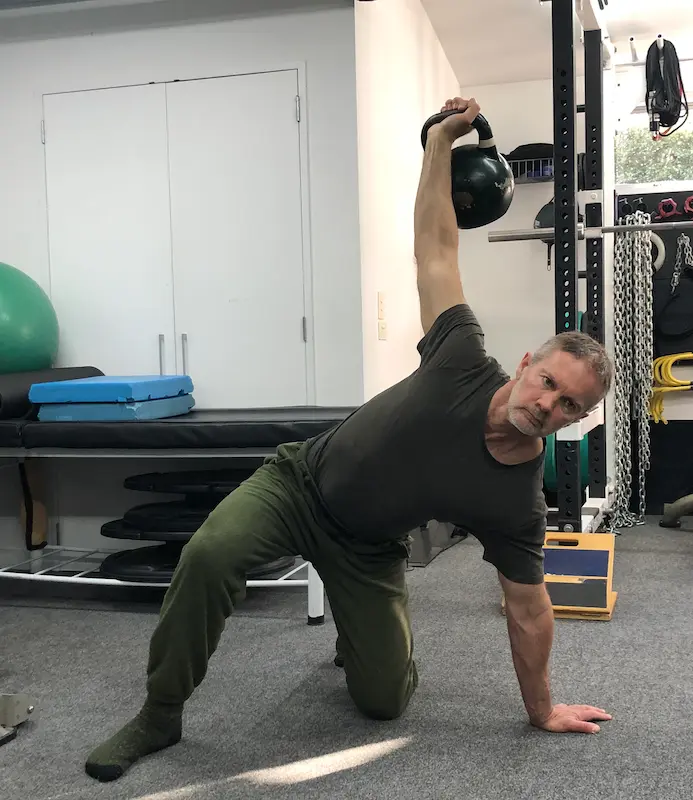
The Functional Value of Getting Up Off the Floor
In physical preparation, few movements are as revealing—or as foundational—as the ability to get up off the floor.
While often overlooked in modern gym environments, this simple act encapsulates complex interactions between mobility, stability, strength, coordination, and balance.
It is, in essence, a full-body expression of integrated human movement.
A Marker of Functional Integrity
The process of rising from the floor represents far more than a basic transition—it’s a functional diagnostic.
The way an individual moves through this sequence provides deep insight into joint mechanics, force transfer, and motor control across multiple planes.
When movement is smooth and coordinated, it indicates efficient neuromuscular sequencing and appropriate load distribution through the kinetic chain.
Conversely, compensations such as collapsing knees, trunk rotation, or reliance on momentum highlight mobility restrictions, strength asymmetries, or motor control deficits.
From a performance lens, this pattern reveals how effectively an athlete organizes movement under load.
From a health perspective, it directly relates to long-term independence: the ability to get up off the floor without assistance is strongly correlated with reduced fall risk and improved longevity.
In short, how you move off the ground reflects how well your system functions as a whole.
Fundamental Variations and Their Attributes
Each method of getting up emphasizes a different quality within the functional hierarchy.
Progressively incorporating these variations builds a foundation of controlled strength and adaptable movement capacity.
-
Cross-Leg Sit to Stand
Prioritizes hip mobility, trunk control, and balance. This variation emphasizes eccentric control of the hips and knees and serves as a reliable baseline test for lower-body mobility and stability. -
Half-Kneel to Stand
Develops unilateral hip stability and gait coordination. This pattern reinforces the transitional control needed for walking, running, or split-stance performance under load. -
Turkish Get-Up
A multi-planar sequence that integrates shoulder stability, thoracic mobility, and total-body coordination. It’s one of the most comprehensive single exercises for linking the upper and lower kinetic chains through the core. -
Bear Crawl to Stand
Reinforces contralateral (cross-body) patterning, reflexive core activation, and scapular control. This movement retrains the developmental sequencing that underpins efficient gait and athletic agility. -
Deep Squat Rise
Challenges postural strength and full-range mobility of the hips, knees, and ankles. The ability to perform this movement without restriction or compensation reflects well-maintained joint health and neuromuscular elasticity.\
Loading Progressions: From Control to Capacity
Establishing movement quality precedes loading. Once an individual can perform each variation smoothly and symmetrically, gradual increases in mechanical demand can safely enhance neuromuscular coordination and force capacity.
-
Assisted to Unassisted
Begin with hand or dowel support to reduce balance demands, then remove assistance to emphasize pure body control. -
Asymmetrical Loading
Add a kettlebell or sandbag on one side to challenge anti-rotation control and cross-pattern stabilization. This improves the body’s ability to resist unwanted torque and maintain alignment under uneven load. -
Turkish Get-Up Progression
Start with bodyweight, then light load (4–8 kg), progressing to heavier resistance only when control and alignment are maintained throughout the sequence. -
Time Under Tension
Slow the movement down, pausing at transitional points—such as side support or half-kneel—to reinforce joint stability, proprioception, and segmental control. -
Integrated Conditioning
Combine get-up patterns with crawling, sled work, carries, or lunges to develop seamless movement sequencing, acceleration strength, and force transfer across multiple movement contexts.
The key principle: load movement integrity, not compensation.
Every progression should enhance, not distort, the foundational pattern.
How and When to Integrate Into Training
The “get-up” and its variations can be used strategically within almost any training system—from corrective exercise and warm-up work to strength and conditioning blocks.
1. Movement Preparation / Warm-Up
Early in the session, use unloaded or lightly loaded get-ups to prepare the body for complex training.
These sequences elevate core temperature, mobilize the hips and thoracic spine, and prime the nervous system for coordinated movement.
-
Ideal Placement: After general mobility and before loaded strength work.
-
Focus: Controlled tempo, breath awareness, and precise sequencing.
2. Strength Integration
In the main training phase, get-up variations can serve as primary or accessory strength exercises depending on the goal.
Loaded Turkish get-ups or half-kneel to stand variations under load develop dynamic stability and cross-chain integration without the joint shear of traditional bilateral lifts.
-
Ideal Placement: Mid-session, paired with complementary lifts (e.g., deadlifts, presses).
-
Focus: Controlled force production, postural integrity, and tension management.
3. Conditioning and Movement Capacity
In conditioning circuits, integrate get-up patterns with sled drags, loaded carries, or crawling variations to create full-body sequences that demand endurance, coordination, and mechanical efficiency.
These combinations simulate real-world physical challenges where strength, mobility, and coordination must coexist under fatigue.
-
Ideal Placement: End of session or as a separate movement conditioning block.
-
Focus: Sustained quality under metabolic stress—maintaining control despite fatigue.
Beyond Exercise: A Measure of Resilience
Being able to get up off the floor is not a measure of strength in isolation—it’s a measure of integration.
It demonstrates how well the body’s systems communicate, stabilize, and produce force in a coordinated manner.
In athletes, it predicts readiness and efficiency.
In older populations, it determines independence and safety.
For everyone, it reinforces the principle that true functional capacity begins on the ground—where mobility, stability, and strength intersect.
When you can move well from the floor, you don’t just perform better; you move through life with greater resilience, control, and confidence.
Functional strength doesn’t start with a barbell—it starts with the body’s ability to organize itself against gravity.
And that process begins right where human movement began: on the floor.
Peter Rouse is an elite personal trainer in Queenstown, New Zealand, specializing in performance training, corrective exercise, and injury prevention. With over 20 years of experience in exercise physiology, biomechanics, and human performance, Peter helps clients—from everyday professionals to elite athletes—achieve lasting results through evidence-based training systems. As the founder of the Integrated Performance Institute, he also educates fitness professionals worldwide through advanced workshops, seminars, and certification programs. Learn more about his personal training services at www.peterrouse.com and professional education programs here.